

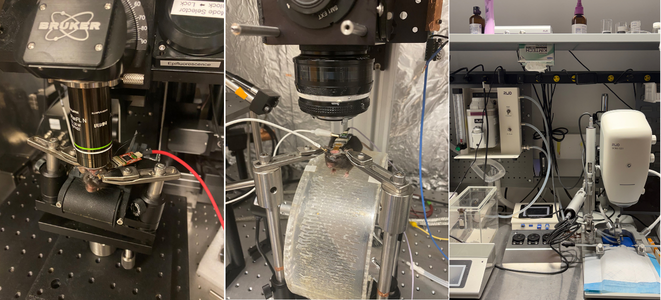
Our laboratory integrates one-photon (1P) and two-photon (2P) microscopy systems, extracellular electrophysiology systems (Open Ephys and Intan RHS), and a small-animal stereotaxic surgery platform to support in vivo neuroscience research. The 1P system supports wide-field fluorescence imaging for routine cellular and structural analysis, while the 2P system enables high-resolution imaging in living tissue with reduced photodamage, allowing visualization of neuronal activity and structures across different spatial scales. Our electrophysiology platforms support neural recording and stimulation, enabling analysis of neuronal activity. The stereotaxic system with isoflurane anesthesia supports procedures such as viral injection, cranial window implantation, and electrode placement for experimental preparation.
One-Photon (1P) Fluorescence Microscope
Our one-photon (1P) fluorescence microscope supports high-resolution imaging of fluorescently labeled cells and tissue samples. The system uses visible light excitation and multiple filter sets to detect different fluorophores, making it ideal for structural analysis and routine imaging experiments. Equipped with high-quality objectives and epifluorescence capabilities, it allows reliable visualization of cellular morphology and protein expression. This platform supports quantitative imaging and systematic documentation of experimental outcomes.
Two-Photon (2P) Microscope – Bruker Multiphoton System
Our Bruker two-photon (2P) microscope enables in vivo imaging using femtosecond pulsed lasers, including tunable Ti:sapphire sources and a fixed-wavelength beam. Two-photon excitation restricts fluorescence to the focal plane, minimizing photodamage and enabling real-time imaging of neural activity and cellular dynamics in living tissue. The system includes a high numerical aperture water-immersion objective, precision scanning components, and a vibration-isolated stage for stable recordings.
Extracellular Electrophysiology Recording Systems — Open Ephys and Intan RHS
Our laboratory maintains two extracellular electrophysiology platforms (Open Ephys and Intan RHS) to support in vivo neural recording and stimulation experiments. Open Ephys is optimized for flexible, high-fidelity recording, while Intan RHS enables both recording and precise electrical stimulation. Lightweight headstages interface with implanted electrode arrays, allowing real-time recordings in awake and anesthetized animals. These systems support analyses including local field potentials (LFP), multi-unit activity, and spike sorting of single-unit activity. Integrated with our stereotaxic surgery platform, they enable stable chronic recordings for characterizing neuronal activity at both single-cell and population levels.
Mouse Stereotaxic Surgery System
Our laboratory is equipped with a mouse stereotaxic surgery system (RWD DOM-1001) designed for neurosurgical procedures in rodent models. The setup includes a stereotaxic frame with micromanipulators, an isoflurane anesthesia delivery system, and a stable surgical platform, supporting procedures such as viral injection, cranial window implantation, and electrode placement.